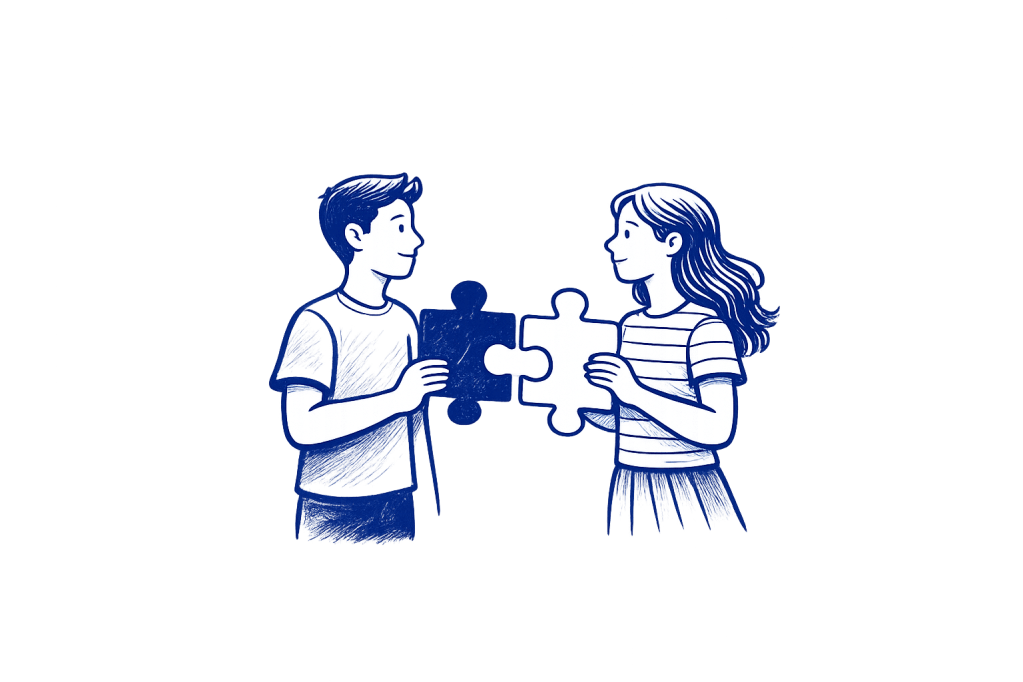
Have you ever stopped to think about who actually taught us how to be men and women?
Because the truth is… nobody ever really explained it to us.
There was no class, no manual, no clear moment where someone said, “this is how you should be.” And yet, somehow, we all grew up learning the same things. Boys should be strong, independent, and not too emotional. Girls should be kind, patient, and take care of others.
And the most interesting part?
We didn’t learn this by being told.
We learned it by watching.
We watched how people reacted. What made others uncomfortable. What got rewarded. A boy cries and the room goes silent — so he learns to hide it. A girl helps others and gets praised — so she learns that caring is expected from her.
Little by little, these moments shape us.
Not in a dramatic way. But quietly. Repeatedly. Until one day, these patterns don’t feel like lessons anymore. They feel like truth.
But what if they’re not?
What if most of what we believe about gender roles was never natural to begin with?
Research actually supports this idea. What we call “natural behavior” is often something we learned through gender socialization — the process where society teaches us what is expected from us based on gender. A study by Halpern and Perry-Jenkins (2016) showed that children are influenced more by what they observe than by what they are told.
So it’s not just about what we hear.
It’s about what we see — every single day.
And those messages don’t just come from family. They come from everywhere. School. Media. Culture. History.
For centuries, women were excluded from leadership, education, and decision-making roles. And when people don’t see something for long enough, they start believing it doesn’t belong there.
That leadership belongs to men.
That care belongs to women.
But modern research tells a different story.
Hyde (2005) showed that men and women are actually more similar than different across most psychological traits, including leadership and cognitive ability. In other words, ability is not the problem.
Opportunity is.
And yet, even today, these stereotypes still shape how people are seen. A study by Moss-Racusin et al. (2012) found that identical job applications were rated differently depending only on the name. Male applicants were perceived as more competent and even offered higher salaries.
Same skills. Different outcome.
But this system doesn’t only affect women.
It affects men too.
Because while women are often limited by expectations, men are often trapped by them. Many grow up feeling like they can’t show weakness, can’t ask for help, can’t express emotion. And that has consequences. According to the World Health Organization (2018), these expectations contribute to men avoiding help-seeking, increasing loneliness and mental health struggles.
So this isn’t just a “women’s issue.”
It’s a human issue.
And once you see it like this, something changes.
It stops being about men versus women.
And starts being about the system we all inherited.
A system that was built in a different time, for different realities.
But we don’t live in that world anymore.
Today, what actually makes relationships and societies work is not rigid roles.
It’s empathy. Communication. Flexibility. Shared responsibility.
And none of those belong to one gender.
They belong to all of us.
So maybe the real question isn’t just who taught us these roles.
Maybe the real question is:
Do we still want to follow them?
Because once you start questioning these stereotypes, you gain something powerful.
Choice.
The choice to express emotions without shame.
The choice to pursue opportunities without limits.
The choice to build relationships based on understanding, not expectations.
And maybe that’s where real change begins.
Not by blaming each other.
But by becoming aware.
And choosing to do better.
 Beyond Gender Wars
Leave a comment